DTV rules changed on 31 August 2026: apply in your country of nationality or legal residence, and bring a criminal record certificate.DTV rules changed on 31 Aug 2026. See what changed

Home / DTV rule changes

DTV rule changes (updated 17 September 2026)

A dated log of Destination Thailand Visa rule changes and how embassies are applying them.

Accurate as of · Reviewed by the DTVThailand.legal team

Current rules in short

Since 31 August 2026 you must apply for the DTV in your country of nationality or a country where you hold legal residence, prove that residence, and include a criminal record certificate. Everything else (5-year validity, 180-day stays, 500,000 THB funds, 10,000 THB fee) is unchanged.

15 September 2026

Visa-free stays cut to 30 days (affects DTV planning)

Since 15 September 2026, travellers from the 60 visa-exempt countries (including the EU, UK, US, Canada and Australia) get 30 days on arrival instead of 60, with one 30-day extension possible at immigration for 1,900 THB. People entering before 15 September keep the stay they were given.

Why it matters for DTV applicants: “come on a visa exemption and sort it out later” now gives you half the time. Apply for the DTV from home before you travel. Source: Royal Gazette notifications of 31 August 2026.

31 August 2026

Apply from home, criminal record certificate required

  1. Where to apply. Applications are accepted only in the applicant's country of nationality or legal residence. Using a third country as a tourist (a common route through Vientiane, Kuala Lumpur or Ho Chi Minh City) is no longer possible.
  2. Proof of residence replaces proof of current location. Non-nationals need legal residence in the country (residence permit, long-term visa or equivalent). Embassies may also ask for proof of address, such as a bank or credit card statement, a utility bill or an ID with your address. A rental agreement or residence registration certificate can also help. Flight tickets, hotel bookings and entry stamps only show where you are, not where you live, so they do not count.
  3. Criminal record certificate is now required, issued by your country of nationality or the country where you apply. Required freshness varies: some ask for one issued within the last 7 or 30 days, others accept a full-history extract.

Who it affects: every new DTV applicant. Transition: applications submitted before 31 August 2026 are processed under the previous requirements (official notice).

The official notice

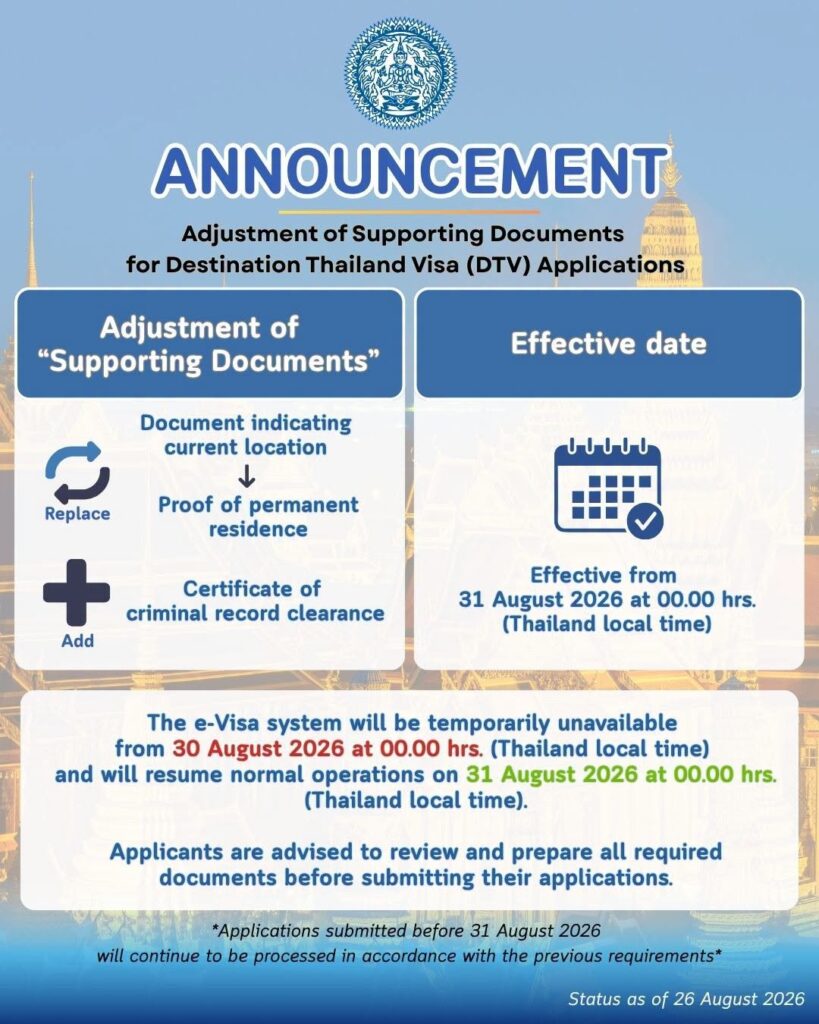
The Thai authorities announced the change on 26 August 2026: the document showing your current location is replaced by proof of permanent residence, and a certificate of criminal record clearance is added. The change took effect on 31 August 2026 at 00:00 Thailand time. Applications submitted before that date continue under the previous requirements.

In practice, embassies accept your country of nationality or a country where you hold legal residence. What counts as proof varies by embassy, so check yours before you apply.

Official Thai announcement: adjustment of supporting documents for DTV applications, effective 31 August 2026
Official announcement, status as of 26 August 2026

How embassies are applying the new rules

Embassies interpret the details differently. We update this table as we confirm each country.

Country / embassyResidence proof acceptedCriminal record freshnessStatement monthsChecked
EstoniaTo be confirmedCertificate via e-File (e-Toimik)To be confirmedSep 2026
More countriesAdded as we confirm them with applicants and embassy pages.

Video: the new DTV rules explained

FAQ

Questions about the 2026 changes

Where do I apply for the DTV after 31 August 2026?

Online, through the official Thai e-Visa system. You first choose the country you are applying from, and the system then assigns the Thai embassy or consulate responsible for it. You can apply from your country of nationality or a country where you hold legal residence. That embassy or consulate processes your application and makes the final decision; there is no in-person submission. Applying as a tourist in a third country is no longer possible. What changed

I live abroad. Can I apply in my country of residence?

Yes, if you hold legal residence there, such as a residence permit or long-term visa. A rental contract or a long stay alone is not enough.

I paid my application before 31 August. Which rules apply?

Applications submitted before 31 August 2026 are processed under the previous requirements, according to the official notice.

What counts as proof of residence?

If you are not a national, you need legal residence: a residence permit, long-term visa or equivalent. Embassies may also ask for proof of address, such as a bank statement, utility bill or ID with your address. A rental agreement or residence registration certificate can also help. Hotel bookings, flight tickets and entry stamps do not count.

What is the criminal record certificate and where do I get it?

It is an official extract from your country's criminal records, often called a police clearance. It must come from your country of nationality or the country where you apply. Embassies differ on how recent it must be, often issued within the last 3 or 6 months.

Sources: Thai e-Visa portal, Royal Thai Embassy notices (August 2026). Requirements can differ by embassy; check yours before applying.

Not sure how the new rules affect you?

Take the free check or have a specialist review your documents.