
What is the Thailand DTV Visa?
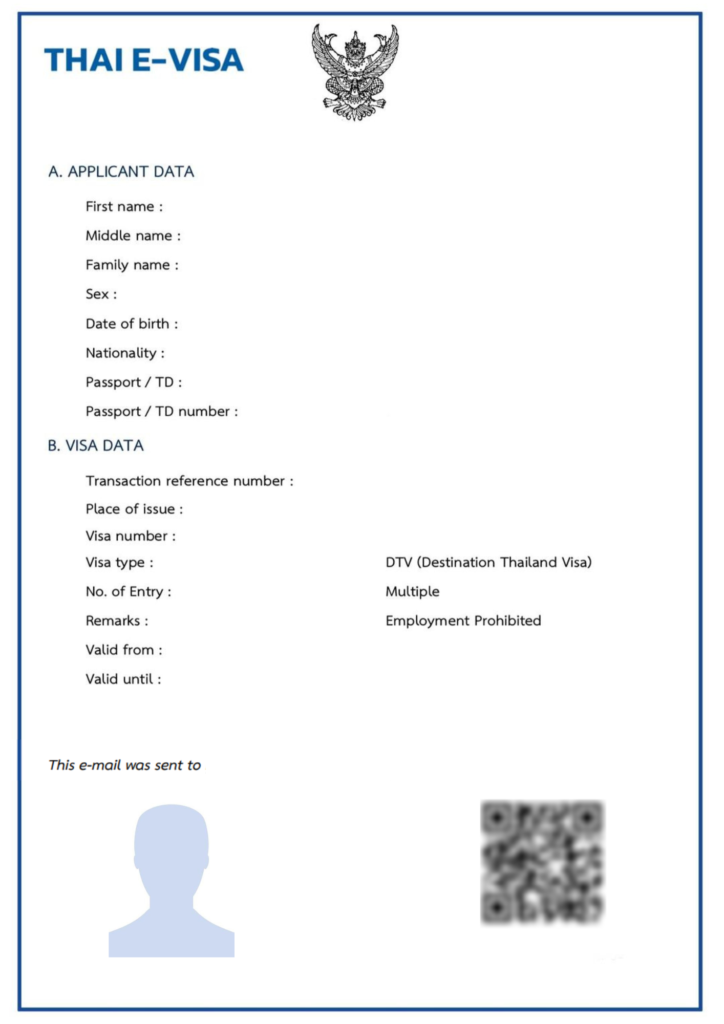
Destination Thailand Visa (DTV) is a 5-year multiple-entry visa designed for individuals who want to live in Thailand while working remotely, joining activities, or staying with family.
- 5-year multiple-entry visa
- Stay up to 180 days per entry
- One additional 180-day extension available at the Thai Immigration Office (1,900 THB fee)
- After the extension, holders must exit and re-enter Thailand to activate a new 180-day stay period
- No mandatory waiting period applies between exits and re-entries
FAQ
Frequently Asked Questions
Is the DTV the same as the “Thailand Digital Nomad Visa”?
Yes. While the official name is the Destination Thailand Visa (DTV), it is commonly referred to as Thailand’s Digital Nomad Visa because it is designed for remote professionals, freelancers and online business owners.
Do I need to file a 90-day report as a DTV holder?
Yes. DTV holders staying in Thailand for more than 90 consecutive days are legally required to submit a 90-day address report to Thai Immigration.
Although the DTV visa allows stays of up to 180 days per entry, the 90-day reporting requirement still applies. Leaving Thailand before your 90th day resets the reporting period upon re-entry.
Important Information:
• Your first report must be completed in person at a Thai Immigration Office
• Future reports can usually be submitted online through the TM47 system
Reporting can be done:
• Up to 15 days before your 90th day
• Or within 7 days after the due date
Required Documents:
• TM47 form
• Passport
• Copies of your passport information page, visa, and latest entry stamp
• TM30 residence registration
• Previous 90-day receipt (if applicable)
Is there a minimum age requirement?
Yes. Primary applicants must be at least 20 years old. Individuals under 20 may apply only as dependents of an approved DTV holder.
Can freelancers apply without a corporate employer?
Yes. Freelancers and self-employed applicants may qualify under the “Workcation” category by providing evidence of ongoing remote work, such as client contracts, invoices, portfolios or a professional website.
Can I work on a Destination Thailand Visa?
Yes, but only remotely for foreign employers or clients. DTV holders are not permitted to work for Thai companies or provide services directly to Thai customers without the appropriate Thai work authorization.
Can I study on a DTV Visa?
The DTV Visa is not intended for full-time university degree programs. However, holders may participate in approved short-term courses and Thai “Soft Power” activities, such as Muay Thai training, cooking classes, seminars, and workshops.
Can I open a business on a DTV Visa?
DTV holders may own shares in a Thai company as shareholders. However, managing day-to-day operations or acting as an authorized director generally requires the appropriate Thai business visa and work permit.
Can I open a Thai bank account with a DTV Visa?
In most cases, no. Under current banking policies, many Thai banks treat the DTV similarly to a tourist visa, which means new bank account applications are often rejected.
Some banks may allow it in limited situations, depending on the branch and supporting documents, but stable long-term banking access on a DTV Visa is generally difficult.
Applicants who require reliable banking access in Thailand may find alternative visa categories, such as the LTR Visa or Thailand Privilege Visa, more suitable.
Can I get a Thai driving license with a DTV Visa?
Yes, although requirements may vary depending on the immigration office and province. In most cases, applicants will need a residence certificate, proof of address, medical certificate and valid passport documents.
Can I switch from a DTV Visa to another visa inside Thailand?
Generally, no. In most cases, applicants wishing to change to another visa category — such as a marriage visa or business visa — must leave Thailand and apply for the new visa from abroad.
Depending on the situation, the existing DTV Visa may first need to be cancelled or converted to a single-entry status before departure.
Who can apply under the Workcation category?
The DTV Workcation category is designed for people who work remotely for foreign companies or clients while living in Thailand.
This category typically includes:
• Remote employees working for foreign employers
• Freelancers with international clients
• Online business owners operating outside Thailand
• Digital creators and online professionals
Remote Employees: You work full-time or part-time for a company located outside Thailand, and your salary is paid from abroad. The DTV visa allows you to stay in Thailand long-term while continuing your remote employment, as long as you are not employed by a Thai company or working for Thai clients.
Freelancers & Online Business Owners: You run your own online business or freelance independently with clients based outside Thailand. This may include professions such as:
• Graphic designers
• Software developers
• Content creators & YouTubers
• Online consultants
• Marketers
• E-commerce business owners
As long as your income, contracts, and clients are foreign-based, the DTV visa allows you to legally stay in Thailand while managing your work remotely.
Can remote employees apply for the DTV Visa?
Yes. Remote employees working full-time or part-time for a foreign company may qualify for the DTV Visa Thailand if their salary is paid abroad.
Can freelancers and online business owners apply?
Yes. Freelancers and business owners working with foreign clients outside Thailand may apply under the Workcation category.
Can I work for Thai companies or clients on a DTV Visa?
No. The Workcation category is intended for remote work connected to foreign employers and international clients only.
What are the main documents required for all applicants?
• Valid passport with at least 6 months of remaining validity
• Passport-style personal photo and passport information page copy
• Proof of current residence/location (e.g., valid visa, receipt(s)/proof(s) of payment of airline tickets, accommodation, entry stamp etc.)
• Proof of financial stability showing at least 500,000 THB (or equivalent foreign currency) in a personal bank account
• Proof of DTV visa fee payment (approximately 10,000 THB, depending on the embassy or consulate)
What documents are required for remote employees?
• Employment contract or employment certificate
• Employer letter confirming remote work status and salary
• Recent payslips or personal tax return (optional but recommended)
What documents are required for business owners?
• Certificate of incorporation or business registration
• Business license (if applicable)
• Corporate tax return or company financial documents
• Cover letter explaining business activities, income structure and remote operations
What documents are required for freelancers?
• Professional portfolio or proof of ongoing work
• Recent invoices or client contracts
• Active professional profiles, website or social media presence related to your work
• Additional proof of remote income or professional activity if requested by the embassy
Can embassies request additional documents?
Yes. Thai embassies and consulates may request additional financial, professional, or supporting documents depending on the applicant’s profile and the embassy’s internal requirements.
In some cases, applicants may also be invited for an interview to clarify their work situation, financial background, travel plans, or the purpose of applying for the DTV visa.
Because requirements can vary between embassies and countries, applicants should always be prepared to provide additional documentation if requested during the application process.
Who can apply under the Thai Soft Power category?
Thai Soft Power Activities include approved long-term activities such as Muay Thai training, cooking courses, medical treatment, sports training, seminars and workshops.
What activities are accepted under the Thai Soft Power category?
• Muay Thai training
• Thai cooking courses
• Medical treatment
• Sports training
• Seminars and workshops
What are the main documents required for all applicants?
• Valid passport with at least 6 months of remaining validity
• Passport-style personal photo and passport information page copy
• Proof of current residence/location (e.g., valid visa, receipt(s)/proof(s) of payment of airline tickets, accommodation, entry stamp etc.)
• Proof of financial stability showing at least 500,000 THB (or equivalent foreign currency) in a personal bank account
• Proof of DTV visa fee payment (approximately 10,000 THB, depending on the embassy or consulate)
What documents are required for Thai Soft Power Activities?
• Official confirmation letter from the host organization (such as a Muay Thai gym, cooking school, medical institution, or training provider)
• Business registration or operating license of the host organization
• Proof of activity duration and participation
• Proof of payment, deposit, or course registration confirmation (recommended)
• Supporting documents showing the activity or program is intended for long-term participation (generally 6 months or longer)
Does the activity need to be long-term?
Yes. Supporting documents should generally show long-term participation, usually six months or longer.
Can I use any company or course for the Thai Soft Power DTV category?
No. The organization or activity provider should be a legitimate and properly operating business or institution that can provide official supporting documents for the visa application.
The embassy may reject applications connected to unclear, unofficial or non-verifiable organizations.
What organizations may qualify under the Thai Soft Power category?
• Cooking
Arun Thai Cooking School (Bangkok)
Bangkok Thai Cooking Academy (Bangkok)
House of Taste Thai Cooking School (Bangkok)
Siam Culinary Academy (Bangkok)
Tingly Thai Cooking School (Bangkok)
InFusion Cooking Classes (Koh Samui)
• Dance
Sri Thepa Vocational and Dance School (Bangkok)
• Muay Thai
Fitfac Muay Thai Academy (Bangkok)
Khongsittha Muay Thai (Bangkok)
Sor Depchant Muay Thai School (Bangkok)
Tiger Eye Muay Thai and MMA (Bangkok)
Core Combat Chiang Mai (Chiang Mai)
Chiangmai Muay Thai Gym (Chiang Mai)
Dang Muay Thai Gym & Muay Thai Gear Shop (Chiang Mai)
Muay Thai Fever – Muay Thai Training Chiang Mai (Chiang MAi)
Elite Fight Club (Bangkok, , Phuket, Hua Hin)
King of Muay Thai Gym (Hua Hin)
Pro Muay Thai Hua Hin (Hua Hin)
Chor.Ratchawat Muay Thai Bophut (Ko Samui)
Fairtex Training Center (Pattaya)
EVO360 Muay Thai (Pattaya)
Petchnumnoi Gym (Sitnumnoi & Singpatong) (Phuket)
Phuket Muay Thai (Phuket)
• Nature
Discover Thai Nature (Bangkok)
Thai Living Landscapes (Bangkok)
• Culture
Thai Cultural Exchange (Bangkok)
TSL Chiang Mai (Chiang Mai)
Who can apply as a dependent under the DTV Visa?
Legal spouses and unmarried children under 20 years old of an approved DTV holder may apply as dependents.
Can my spouse apply together with me for the DTV Visa?
Yes, your spouse can apply, but they cannot apply at the same time on a single joint application. Because visas are tied to individuals, the primary applicant must apply first and receive their visa before the spouse can apply as a dependent.
Can children apply as dependents under the DTV Visa?
Yes. Unmarried children under 20 years old may qualify as dependents.
What are the main documents required for all applicants?
• Valid passport with at least 6 months of remaining validity
• Passport-style personal photo and passport information page copy
• Proof of current residence/location (e.g., valid visa, receipt(s)/proof(s) of payment of airline tickets, accommodation, entry stamp etc.)
• Proof of financial stability showing at least 500,000 THB (or equivalent foreign currency) in a personal bank account
• Proof of DTV visa fee payment (approximately 10,000 THB, depending on the embassy or consulate)
What documents are required for spouses applying as dependents?
Spouses generally need:
• Marriage certificate
• Proof of relationship to the primary DTV holder
Dependent children may need:
• Birth certificate or adoption documents
• Proof of relationship to the primary DTV holder
Can dependents stay in Thailand for the same duration as the main DTV holder?
Generally, dependents receive permission linked to the primary DTV holder’s visa status and validity.
What financial proof is required for the DTV Visa?
Applicants must generally show at least 500,000 THB (or equivalent foreign currency) as proof of financial stability.
What types of financial proof are accepted?
• Personal bank statements
• Savings accounts
• Fixed deposits
• Sponsorship documentation
How many months of bank statements are usually required?
Most embassies request recent bank statements showing approximately 3–6 months of financial history.
Can I use cryptocurrency as proof of funds?
No. Cryptocurrency is generally not accepted as primary proof of funds for the DTV Visa application.
Can I use stocks or investment portfolios as proof of funds?
Generally no. Thai embassies usually require liquid funds held in a personal savings or current account.
Can I use property ownership as proof of funds?
Property ownership is generally not accepted as primary proof of funds.
Can I use a business bank account for the DTV Visa?
Business bank accounts are generally not accepted as the primary financial requirement. Funds should usually be held under the applicant’s personal name.
Do the funds need to be immediately accessible?
Yes. Thai embassies generally require liquid and immediately accessible personal funds.
How long must the 500,000 THB remain in my account?
Most embassies require applicants to maintain the required balance for approximately 3–6 months before applying.
Do I need to keep 500,000 THB in my account for the full 5 years?
No. Proof of funds is generally required during the initial application process and again for a 180-day extension inside Thailand.
Do DTV Visa holders pay taxes in Thailand on foreign income?
Generally, foreign income is not taxed in Thailand unless the holder becomes a Thai tax resident and brings that income into Thailand.
When can tax liability arise in Thailand?
In many cases, tax liability may arise if a person stays in Thailand for more than 180 days in a calendar year and remits foreign income into Thailand during the same tax year.
Can I apply for a DTV Visa while inside Thailand?
No. DTV applications must generally be submitted while physically outside Thailand.
Do DTV application requirements vary by embassy?
Yes. Requirements and requested documents may vary depending on the embassy and country of application.
Can embassies request additional documents?
Yes. Some embassies may request additional financial history, proof of employment or supporting evidence of professional activity.
How long does DTV Visa processing usually take?
Typical processing time is approximately 2–4 weeks depending on the embassy and application complexity.
How much is the DTV Visa government fee?
The standard government fee is approximately 10,000 THB, usually around 350–400 USD depending on the embassy location.
Why are DTV applications rejected?
• Insufficient or non-liquid financial proof
• Applying while inside Thailand
• Missing or incomplete documents
• Weak proof of remote work or professional activity
• Poorly structured or unclear documentation
KEY INFORMATION
Important Things to Know
90-Day Reporting
DTV holders staying in Thailand for more than 90 consecutive days must submit a 90-day address report.
Tax Consideration
Foreign income is generally not taxed unless brought into Thailand and you stay more than 180 days in a tax year.
Apply from Outside Thailand
DTV applications must be submitted while physically outside Thailand through the Thai E-Visa platform.
DTV requirements, requested documents and approval standards may vary depending on the country and Royal Thai Embassy or Consulate handling the application. Individual visa officers may request additional documents, clarification, supporting evidence or interviews before making a final decision.