
Five years in Thailand. One application done right.
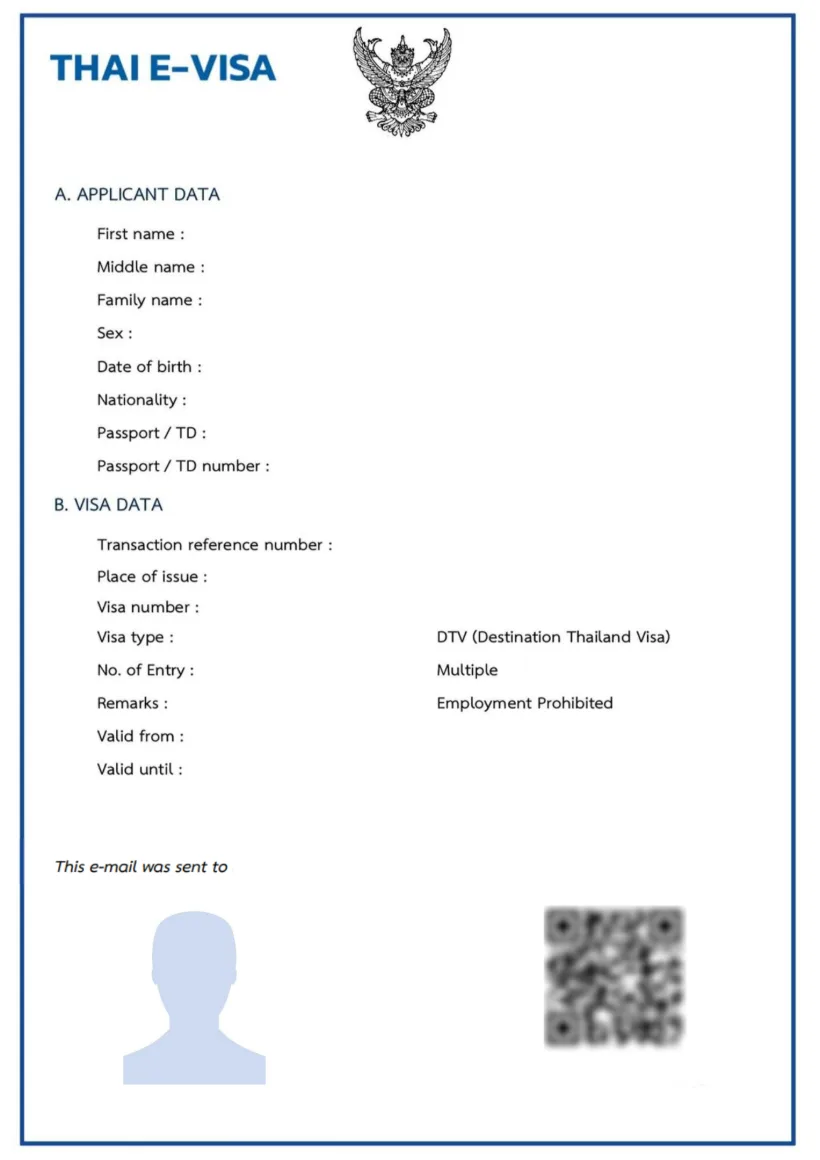
01 About the DTV
What the Thailand DTV actually gives you
- Stay up to 180 days per entry, extendable once by another 180 days (1,900 THB)
- Work remotely for foreign clients and employers
- Bring your spouse and children under 20
- No employment for Thai companies or clients
“A strong DTV application is not a pile of valid documents. It is one clear, consistent story that an embassy officer can follow without guessing.”
DTVThailand.legal team02 New in 2026
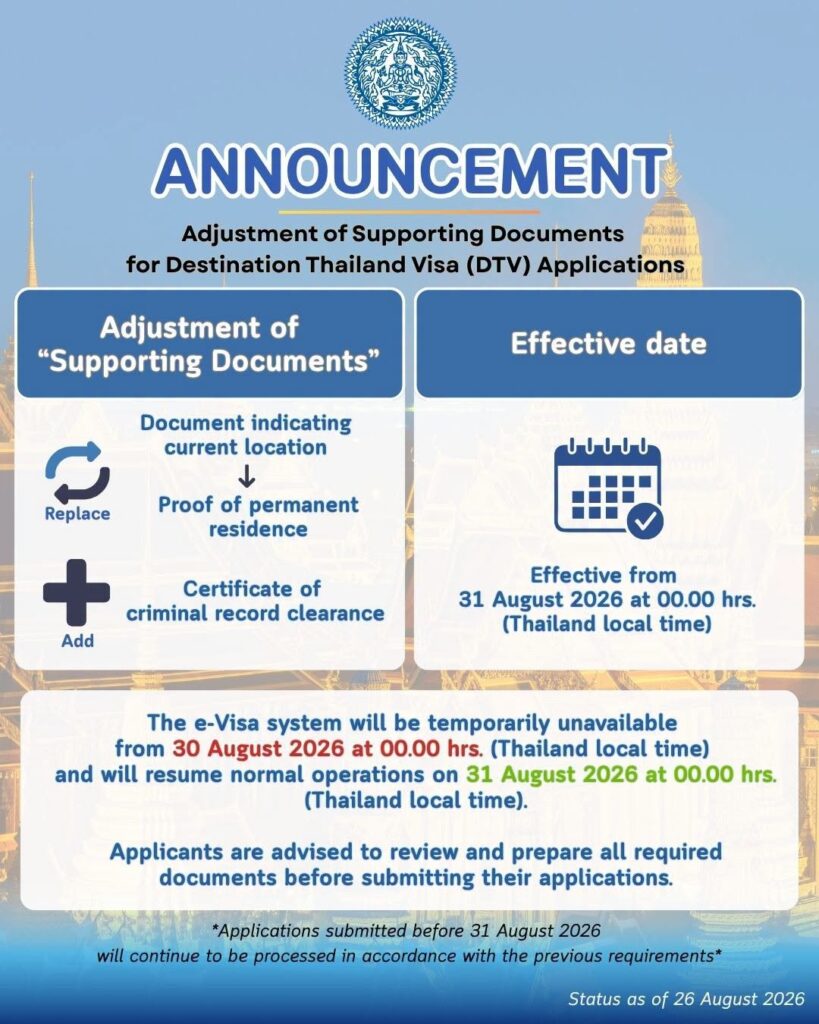
What changed on 31 August 2026
- Where you apply. Only in your country of nationality or where you hold legal residence. Applying as a visitor in a third country is no longer possible.
- Proof of permanent residence replaces the document showing your current location.
- Criminal record certificate is now required.
Applications submitted before 31 August 2026 are processed under the previous requirements.
03 DTV categories
Three paths to your Thailand visa



04 Avoid a refusal
Five mistakes that risk a refusal
05 Our process
From first message to submission, in four steps
01
Free check or chat
02
Eligibility & strategy
03
Document preparation
04
Submission
06 Pricing
Two ways to work with us
DTV Document Audit
$249 one-time
- Embassy requirements review
- Eligibility & document verification
- Financial & income assessment
- Risk assessment & recommendations
- Delivered in 4–6 business days
Full Application Management
$499 one-time
- Strategy based on category & embassy
- Personalised document preparation
- Financial & income proof preparation
- Embassy-ready package & e-Visa application filled in for you
- Support until the decision
The government DTV visa fee (10,000 THB, paid in local currency) is paid by you directly in the Thai e-Visa system. Prefer to do it yourself? See the DTV document guides
Free download
The DTV document checklist 2026
Every document for your category on one page, updated for the 31 August 2026 rules: residence proof, criminal record certificate and bank statement tips. Tick it off online or save it as a PDF.
DTV checklist 2026
- ☑ Passport, 6+ months valid
- ☑ Proof of residence
- ☑ Criminal record certificate
- ☐ Bank statements, 500,000 THB
- ☐ Category evidence
- ☐ Translations
07 Guides & insights
Everything you need to know, explained simply
What embassies look for in your statements, how long the money must sit there, and what does not count.
Read guide →Nationality or legal residence, proof of residence, the criminal record certificate and the new 30-day visa exemption.
Read guide →What an agent actually does, red flags to avoid, and when paying for help is worth it.
Read guide →Watch on YouTube
New rules from 31 August
Financial requirements
Workcation vs Thai Soft Power
08 FAQ
Clear answers to the questions that matter
Still have questions?
Message us on WhatsApp and we will talk your situation through before you pay anything.
Chat on WhatsAppWhat is the Destination Thailand Visa (DTV)?
The DTV is a 5-year, multiple-entry Thai visa for remote workers, participants in Thai Soft Power activities, and their spouses and children. Each entry allows up to 180 days, which you can extend once by another 180 days at Thai Immigration for 1,900 THB. After that, you leave and re-enter to start a new stay.
Is DTV approval guaranteed?
No. The Royal Thai Embassy or Consulate makes the final decision, and no agency can guarantee approval. A complete, consistent application with clear financial proof reduces the risk of refusal and of extra document requests.
How long does the DTV take?
Processing ranges from a few business days to several weeks after a complete submission, depending on the embassy. If you use our services, document preparation takes a further 4 to 6 business days before submission, so plan for about a month in total.
Where do I apply for the DTV after 31 August 2026?
Online, through the official Thai e-Visa system. You first choose the country you are applying from, and the system then assigns the Thai embassy or consulate responsible for it. You can apply from your country of nationality or a country where you hold legal residence. That embassy or consulate processes your application and makes the final decision; there is no in-person submission. Applying as a tourist in a third country is no longer possible. What changed
Who can apply under the Workcation category?
Remote employees of foreign companies, freelancers with clients outside Thailand, owners of online businesses based abroad, and professional creators with real income. Your work and income must come from outside Thailand.
Can freelancers apply without an employer?
Yes. Freelancers and self-employed people qualify if they can show ongoing work for foreign clients, such as contracts, recent invoices and a portfolio or professional website. The income should also be visible in your bank statements.
Can I work for Thai companies or Thai clients on a DTV?
No. The DTV allows remote work only for employers and clients outside Thailand. Working for a Thai company or serving Thai customers requires a proper work visa and work permit.
What activities count as Thai Soft Power?
Muay Thai and martial arts, Thai cooking courses, medical treatment, sports training, seminars and workshops, and similar cultural programmes with a registered Thai provider. Thai language schools are no longer accepted.
Can I use any gym, school or course?
No. The provider must be a registered or licensed Thai business that can issue an acceptance letter in your name and show its registration. Embassies refuse applications linked to providers they cannot verify.
How long must the activity last?
It depends on the embassy. Some expect participation covering at least six months, others want the activity to match how long you plan to stay. Your confirmation letter should state clear start and end dates and the schedule.
Who can apply as a DTV dependent?
The legal spouse and children under 20 (including adopted children) of a DTV holder. Unmarried partners generally do not qualify.
Can my spouse apply at the same time as me?
Not on one joint application. Each person applies and pays separately, and the main applicant needs an approved DTV before the spouse or children apply as dependents, because their application refers to it.
What documents do dependents need?
On top of the core documents: the main holder's DTV and passport copy, a marriage certificate or a birth or adoption certificate (translated into English or Thai, and certified or apostilled where required), and a sponsorship letter if the holder supports them financially.
How much money do I need for the DTV?
At least 500,000 THB, or the equivalent in your currency, in a personal bank account in your name. Embassies ask for statements covering the last 3 or 6 months, depending on the embassy. A large recent deposit is fine if you can show where it came from.
How many months of bank statements do I need?
At least 3 months; some embassies ask for 6. Check your embassy's current checklist before you order statements.
Can I use cryptocurrency, stocks or property?
Not as primary proof. Embassies want liquid money in a personal bank account. You can move funds into your account, but do it early and be ready to explain large deposits.
Do I need to keep 500,000 THB for all five years?
No. You show the funds when you apply, and again when you request a 180-day extension in Thailand. Keeping a healthy balance makes both easier.
Do requirements differ between embassies?
Yes. Embassies differ on bank statement months, police certificate freshness, translations and extra documents. We track differences in our rule changes log.
How much is the DTV visa fee?
10,000 THB, charged in the embassy's local currency, so the exact amount varies by country. The fee is non-refundable, even if the application is refused.
What counts as proof of residence?
If you are not a national, you need legal residence: a residence permit, long-term visa or equivalent. Embassies may also ask for proof of address, such as a bank statement, utility bill or ID with your address. A rental agreement or residence registration certificate can also help. Hotel bookings, flight tickets and entry stamps do not count.
What is the criminal record certificate and where do I get it?
It is an official extract from your country's criminal records, often called a police clearance. It must come from your country of nationality or the country where you apply. Embassies differ on how recent it must be, often issued within the last 3 or 6 months.
Ready to start your life in Thailand?
Independent Destination Thailand Visa (DTV) assistance for digital nomads, remote professionals, Soft Power participants and families. Not a law firm and not affiliated with the Thai government.
© 2026 DTVThailand.legal. All rights reserved.Final visa decisions are made by the Royal Thai Embassy or Consulate.