
What the official notice says
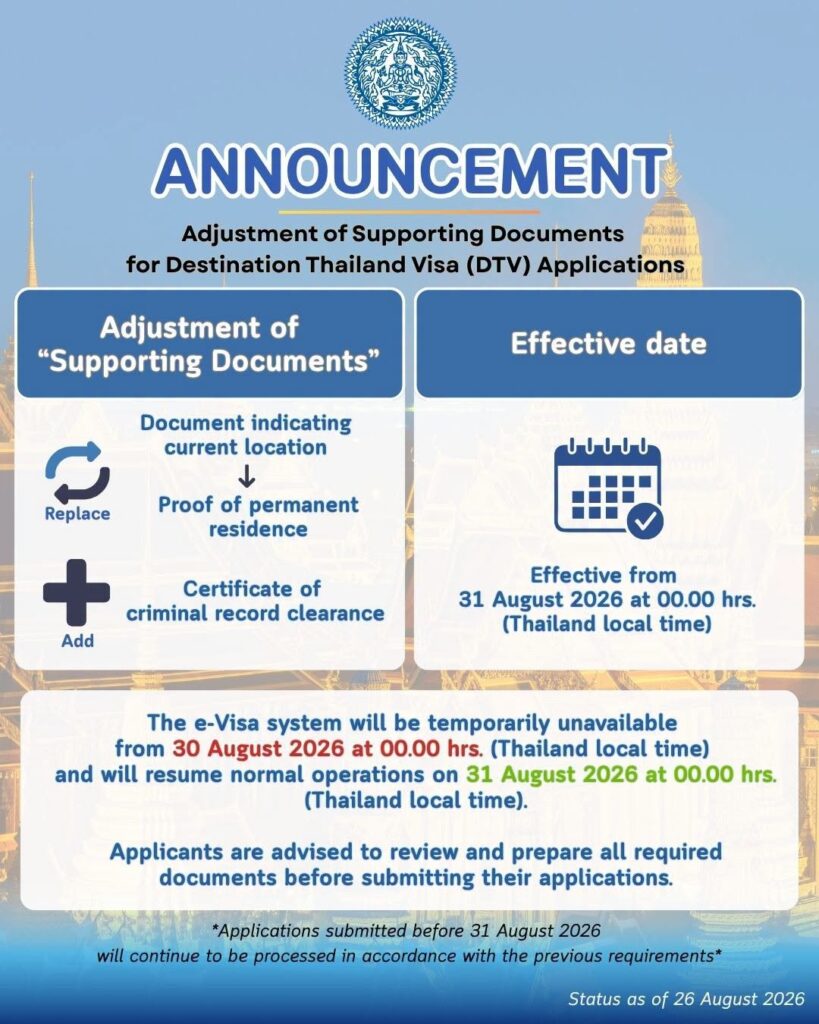
The Thai announcement (status as of 26 August 2026) lists two adjustments to the supporting documents for DTV applications:
- Replaced: "Document indicating current location" becomes "Proof of permanent residence".
- Added: Certificate of criminal record clearance.
The change took effect on 31 August 2026 at 00:00 Thailand time. The e-Visa system was offline on 30 August for the update. Applications submitted before 31 August continue under the previous requirements.
Where you can apply now
In practice, embassies accept applications from:
- your country of nationality, or
- a country where you hold legal residence (for example a residence permit or long-term visa).
What is gone is the popular route of flying to a neighbouring country (Vientiane, Kuala Lumpur, Ho Chi Minh City) and applying there as a tourist. Dual nationals should check with the embassy which nationality they may use.
Not sure you qualify?Take the free 2-minute DTV eligibility check.
Start the free checkWhat counts as proof of residence
The notice uses the words "proof of permanent residence", and each embassy decides what it accepts. If you apply outside your home country, expect to need a residence permit, residence card or long-term visa for that country. Some embassies may also ask for proof of your address, such as a recent bank statement or utility bill in your name. A rental contract or hotel booking on its own is generally not enough.
Because embassies differ, check your embassy's current checklist, or let us check it for you with a document audit.
The new criminal record certificate
Every applicant now needs a certificate of criminal record clearance, issued by the country of nationality or the country where the application is made. Required freshness varies: some embassies want a certificate issued within the last 7 or 30 days, others accept a full-history extract. See our guide on how to get a criminal record certificate for the DTV.
Also new: visa-free stays cut to 30 days (15 September 2026)
A separate change took effect on 15 September 2026: travellers from the 60 visa-exempt countries (including the EU, UK, US, Canada and Australia) now get 30 days on arrival instead of 60, with one 30-day extension possible for 1,900 THB. The old plan of "enter visa-free and sort out a long-stay visa later" now gives you half the time, so apply for the DTV from home before you travel.
What did not change
- 5-year validity, multiple entries
- Up to 180 days per entry, one 180-day extension (1,900 THB)
- 10,000 THB government fee, paid in local currency
- 500,000 THB proof of funds
- The three categories: Workcation, Soft Power, Dependents
Want an expert to check your documents?Document Audit USD 249 · Full service USD 499
See the audit