
Workcation
(Digital Nomads, Freelancers, Remote Workers)
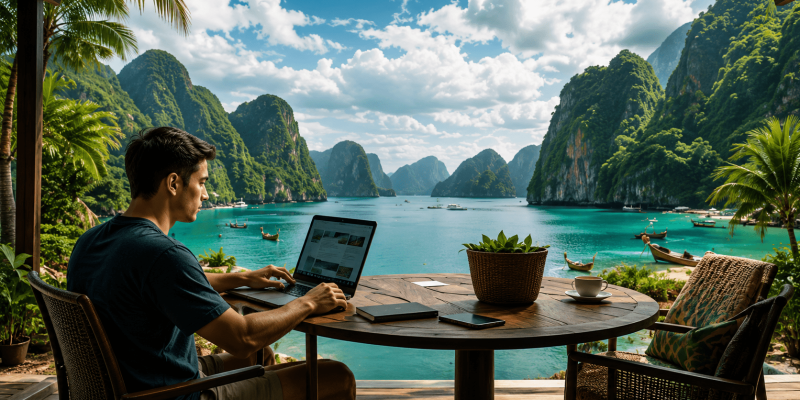
For remote professionals who work online for foreign companies or run their own business from anywhere in the world.
- Remote employees & freelancers
- Online business owners
- Content creators & digital entrepreneurs
- No minimum income requirement specified by the Thai government
Core Documents (Required for All Applicants)
- Valid passport with at least 6 months of remaining validity
- Passport-style personal photo and passport information page copy
- Proof of current residence/location (e.g., valid visa, receipt(s)/proof(s) of payment of airline tickets, accommodation, entry stamp etc.)
- Proof of financial stability showing at least 500,000 THB (or equivalent foreign currency) in a personal bank account
- Proof of DTV visa fee payment (approximately 10,000 THB, depending on the embassy or consulate)
Specific Documents — Workcation Category
For Employees
- Employment contract or employment certificate
- Employer letter confirming remote work status and salary
- Recent payslips or personal tax return (optional but recommended)
For Business Owners
- Certificate of incorporation or business registration
- Business license (if applicable)
- Corporate tax return or company financial documents
- Cover letter explaining business activities, income structure and remote operations
For Freelancers
- Professional portfolio or proof of ongoing work
- Recent invoices or client contracts
- Active professional profiles, website or social media presence related to your work
Who can apply under the Workcation category?
The DTV Workcation category is designed for people who work remotely for foreign companies or clients while living in Thailand.
This category typically includes:
• Remote employees working for foreign employers
• Freelancers with international clients
• Online business owners operating outside Thailand
• Digital creators and online professionals
Remote Employees: You work full-time or part-time for a company located outside Thailand, and your salary is paid from abroad. The DTV visa allows you to stay in Thailand long-term while continuing your remote employment, as long as you are not employed by a Thai company or working for Thai clients.
Freelancers & Online Business Owners: You run your own online business or freelance independently with clients based outside Thailand. This may include professions such as:
• Graphic designers
• Software developers
• Content creators & YouTubers
• Online consultants
• Marketers
• E-commerce business owners
As long as your income, contracts, and clients are foreign-based, the DTV visa allows you to legally stay in Thailand while managing your work remotely.
Can remote employees apply for the DTV Visa?
Yes. Remote employees working full-time or part-time for a foreign company may qualify for the DTV Visa Thailand if their salary is paid abroad.
Can freelancers and online business owners apply?
Yes. Freelancers and business owners working with foreign clients outside Thailand may apply under the Workcation category.
Can I work for Thai companies or clients on a DTV Visa?
No. The Workcation category is intended for remote work connected to foreign employers and international clients only.
What financial proof is required for the DTV Visa?
Most Thai embassies and consulates require DTV applicants to provide proof of financial stability showing at least 500,000 THB (or the equivalent in another currency) held in a personal bank account.
The exact financial requirements and accepted document formats may vary depending on the embassy, country of application, and the applicant’s overall situation.
In most cases, embassies request:
• Personal bank statements
• Proof that the funds are genuinely available and accessible
• Financial documents covering the previous 3-6 months (sometimes longer depending on the embassy)
Accepted financial proof usually includes:
• Personal bank statements
• Savings accounts
• Fixed deposits
• Sponsorship documentation
Some embassies may also request additional supporting financial documents depending on the applicant’s situation and DTV category.
Please note that certain asset types may not always be accepted as primary financial proof, including:
• Cryptocurrency holdings
• Stocks or investment portfolios
• Property valuations
• Business accounts not held personally in the applicant’s name
Financial requirements, document standards, and review practices can differ between embassies and may change without prior notice. In some cases, embassies may request additional financial evidence, clarification documents, or further verification during the application process.
Do the funds need to be immediately accessible?
Yes. Thai embassies generally require liquid and immediately accessible personal funds.
Do I need to keep 500,000 THB in my account for the full 5 years?
No. Proof of funds is generally required during the initial application process and again for a 180-day extension inside Thailand.
Do DTV Visa holders pay taxes in Thailand on foreign income?
Generally, foreign income is not taxed in Thailand unless the holder becomes a Thai tax resident and brings that income into Thailand.
In many cases, tax liability may arise if a person stays in Thailand for more than 180 days in a calendar year and remits foreign income into Thailand during the same tax year.
Have more questions? We’re here to help. Chat with us on WhatsApp or email our experts.